What makes EASE different from other CHED scholarships: The EASE (Expanded Access to Scholarships for Equity) Program is specifically designed for students who belong to Special Equity Groups (SEGs) – PWDs, solo parents and their children, senior citizens, indigenous peoples, and underprivileged/homeless citizens. It is not a merit-only scholarship: equity group membership is the primary gateway, and the income ceiling is a generous ₱2,000,000 – far higher than most other CHED grants.

| Details | Information |
|---|---|
| Program name | CHED EASE Scholarship Program (Expanded Access to Scholarships for Equity) |
| Administered by | Commission on Higher Education (CHED) |
| Who qualifies | First-year college students belonging to recognized Special Equity Groups (SEGs) |
| Minimum GWA | 85% or its equivalent (Senior High School) |
| Income ceiling | ₱2,000,000 annual gross (individual if employed / combined if dependent) |
| School types | PHEIs, SUCs, LUCs with IR – enrolled in CHED Priority Programs |
| Application deadline | July 31, 2026. |
| Application mode | Online only – EASE Application Portal |
What is the CHED EASE Scholarship?
The CHED EASE (Expanded Access to Scholarships for Equity) Program is a government-funded scholarship specifically created for incoming first-year college students who belong to Special Equity Groups (SEGs) groups that have historically faced social, economic, and systemic barriers to higher education.
Unlike the CHED Merit Scholarship (which requires a 93%+ GWA) or the Tulong Dunong Program (which focuses on financial need), EASE is equity-first: your membership in a recognized SEG is the primary qualifier, supplemented by a minimum 85% GWA and an income ceiling of ₱2,000,000.
This is one of the highest income ceilings in any CHED scholarship program, making it accessible to a wide range of families.
READ: How to Apply for the Security Bank Scholarship 2026
Who qualifies – Special Equity Groups (SEGs)
To apply for EASE, you must be a certified member of at least one of the following recognized Special Equity Groups:
| Special Equity Group (SEG) | Legal Basis | Required Proof of Eligibility |
|---|---|---|
| Persons with Disabilities (PWDs) | RA 7277, as amended | PWD ID issued by the PDAO or certification from the C/MSWDO |
| Solo Parents and Their Children | RA 8972 (Solo Parents’ Welfare Act) | Valid Solo Parent ID issued by the C/MSWDO |
| Senior Citizens | RA 9994 (Expanded Senior Citizens Act) | Senior Citizen ID issued by the OSCA |
| Indigenous Cultural Communities / Indigenous Peoples (ICCs/IPs) | RA 8371 (Indigenous Peoples’ Rights Act or IPRA) | Certification issued by the NCIP |
| Poor, Underprivileged, and Homeless Citizens | Magna Carta for the Poor | Certification from the DHSUD or C/MSWDO, or inclusion in the Community-Based Monitoring System (CBMS) |
Pro tip – “Solo Parents and their Children” includes you even if you are the child
This is one of the most commonly misunderstood SEG categories. If your parent is a certified solo parent under RA 8972, you as the dependent child qualify for EASE under this category – you don’t need to be a solo parent yourself. Submit a copy of your parent’s valid Solo Parent ID from the C/MSWDO. If your parent’s Solo Parent ID has expired, have them renew it at the C/MSWDO before you apply – an expired ID will not be accepted.
Eligibility requirements
- Filipino citizen residing in the Philippines
- Duly certified member of at least one recognized Special Equity Group (SEG)
- Graduate of Senior High School in the Philippines with a minimum general average of at least 85% or its equivalent
- Admitted or enrolled in a CHED-identified priority undergraduate program per CMO No. 15, s. 2026, with valid GR or COPC, offered by a PHEI, SUC, or LUC with IR
- Annual gross income does not exceed ₱2,000,000 (individual if employed / combined parents/guardian if dependent)
- EASE covers eligible students regardless of age, sex, sexual orientation, gender identity, civil status, disability, religion, ethnicity, or political affiliation
Documentary requirements
A. Documents (all applicants)
- Photocopy of PSA/NSO Birth Certificate
- Certified True Copy of Form 138 (Learner’s Progress Report Card) or School Form 9 (SF9) signed by the SHS registrar or authorized representative
- Admission Slip or equivalent document from your intended HEI
B. SEG certification, submit the one applicable to your group
- PWD: Valid PWD ID from PDAO or C/MSWDO certification
- Solo Parent / Dependent: Applicant’s or parent’s valid Solo Parent ID from C/MSWDO
- Senior Citizen: Senior Citizen ID from OSCA
- IP / ICC: NCIP Certification
- Underprivileged / Homeless: Certification from Local Housing Office, DHSUD, UPAO, or C/MSWDO; or proof of CBMS inclusion certified by C/MSWDO
- Magna Carta for the Poor: Social Case Study Report or CBMS inclusion proof certified by C/MSWDO
C. Financial documents, submit any one applicable
- ITR (BIR Form 1701/1701A) or BIR Form 2316 showing annual gross income
- Certificate of Tax Exemption or Non-Filer Certificate from BIR
- Certified true copy of contract or proof of income for children of OFWs and seafarers
- Social Case Study Report from C/MSWDO
D. For legal/authorized guardians (if applicable)
- Notarized Certificate of Guardianship issued by the legal guardian
File upload guidelines
| Requirements | Guidelines |
|---|---|
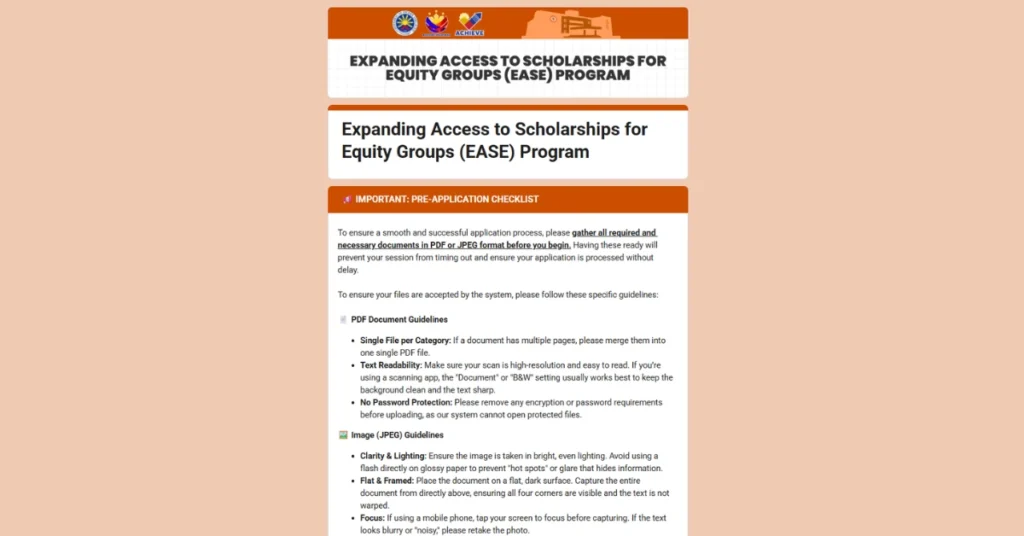
| PDF files | Merge multi-page documents into a single PDF. No password protection. High-resolution scan, use “Document” or “B&W” mode in scanning apps. |
| JPEG images | Bright, even lighting, no flash glare. Place document flat on a dark surface. Capture all four corners. Tap to focus on mobile. |
| File size | Maximum 5MB per file. Use 300 DPI or an online compressor if oversized. |
| File naming | Use: LastName_FirstName_DocumentType e.g. Santos_Maria_BirthCertificate, Santos_Maria_SF9, Santos_Maria_PWD_ID |
| Orientation | All uploads must be upright, rotate before uploading if needed. |
Tip – prepare all documents before opening the portal
The EASE portal may time out if you leave it idle while searching for documents. Prepare, scan, name, and organize all files on your device before clicking the application link. Create a dedicated folder on your phone or computer labeled “EASE 2026” and place all PDFs and JPEGs there, correctly named.
This 10-minute preparation step prevents losing your work mid-application. Set your phone screen timeout to “Never” or “5 minutes” before starting.
READ: Iskolar ng Bayan Scholarship
How to apply for the CHED EASE Scholarship 2026?
Step 1 – Secure your SEG certification first
Visit the issuing office for your SEG category, such as the PDAO (PWD), C/MSWDO (solo parent, underprivileged), OSCA (senior citizen), or NCIP (IP), and obtain a valid, current certification or ID. This is the non-negotiable gateway document. Without it, your application cannot proceed regardless of your grades or income.
Step 2 – Gather your certified SHS Form 138 / SF9
Request a Certified True Copy of your Form 138 or School Form 9 (SF9) from your Senior High School registrar. It must be signed by the registrar or an authorized representative. Allow 3-5 working days, and do not wait until the last week of July.
Step 3 – Prepare financial and supporting documents
Collect the applicable income document for your family’s situation, such as an ITR, BIR Non-Filer Certificate, or Social Case Study Report. Also prepare your PSA Birth Certificate and Admission Slip from your intended HEI. If you have a legal guardian, secure a Notarized Certificate of Guardianship.
Step 4 – Scan, name, and organize all files
Scan or photograph every document following the PDF and JPEG guidelines above. Name each file using the format: LastName_FirstName_DocumentType. Place all files in one folder. Do this before opening the portal.
Step 5 – Open the EASE portal and complete the application.
Go to bit.ly/2026EASEApplicationPortal. Fill in all required fields accurately. Upload documents to the correct sections. Review all information before submitting. Submit before July 31, 2026.
Note: The ₱2,000,000 income ceiling is not a barrier for most families.
Many students who belong to SEGs assume they “earn too much” to qualify for a government scholarship. The EASE income ceiling of ₱2,000,000 annually is deliberately high, and it is designed to ensure that even working-class and lower-middle-income families within SEGs are not excluded. A household earning ₱100,000-₱150,000 per month combined still qualifies. Don’t self-disqualify based on assumptions. Calculate your family’s actual combined annual gross income, compare it to ₱2,000,000, and apply if you fall below the threshold.
Frequently asked questions
What GWA is required for EASE?
A minimum general average of 85% in Senior High School (or its equivalent) is required. This is lower than the CHED Merit Scholarship’s 93% threshold, making EASE more accessible to a wider range of deserving students.
Can I apply for EASE if I already have a TES or Tulong Dunong grant?
EASE guidelines indicate it is available to eligible first-year students belonging to SEGs enrolled in priority programs. Confirm with other CHED grants through the official EASE portal or your CHED Regional Office before applying with existing grants.
I belong to two SEGs (e.g., I am a PWD and a solo parent dependent). Do I get more points?
EASE eligibility requires membership in at least one recognized SEG. If you belong to multiple SEGs, submit certifications for all that apply, as multiple SEG memberships may improve your ranking during evaluation when slots are limited.
Can I apply if I am already in 2nd or 3rd year college?
No. The EASE Program is for eligible first-year students only for AY 2026-2027. Continuing upper-year students are not covered by this program cycle.
What if my PWD ID or Solo Parent ID is expired?
An expired ID will not be accepted. Renew it at the issuing office, such as the PDAO for PWD IDs or the C/MSWDO for Solo Parent IDs, before applying. Renewal typically takes 1-2 weeks, so start the renewal process immediately if your ID is near expiry or already expired.
Does the program cover all college courses?
No. Applicants must be enrolled in a CHED-identified priority undergraduate program per CMO No. 15, s. 2026. Verify that your specific course and school are on the approved list at ched.gov.ph before applying.